Flow Around a Cylinder
Hands-on laboration
Hands-on laboration
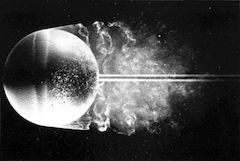 The purpose of this exercise is to introduce you to external flows, more specifically the flow around a cylinder. Although a cylinder is not geometrically complex, flows around cylinders are very complex and includes several interesting flow phenomena that will be investigated in this exercise. The laboratory work will be carried out in the Chalmers Fluid Dynamics Laboratory, which is a well-equipped world-class laboratory, including a large wind tunnel with low-turbulent flow of the highest quality.
Objectives
After completing the course, the student should be able to:
- Define the Reynolds number for different flows Categorize a flow and have knowledge about how to select applicable methods for the analysis of a specific flow based on category
- Explain what a boundary layer is and when/where/why it appears
- Explain how to use non-dimensional numbers and the \(\Pi\)-theorem
- Describe what is characteristic for a turbulent flow
- Explain flow separation (for example separated cylinder flow)
- Explain how to delay or avoid separation
- Understand, explain and use the concepts drag, friction drag, pressure drag, and lift
- Understand and explain how the shape and surface roughness of an object affects drag
- Measure forces on an object in a flow
Outline
The laboratory work will be carried out for a total of 2 hours in the Chalmers Fluid Dynamics Laboratory. After the lab you should write a short report that should be submitted in Canvas. Make sure to keep detailed notes of what you do during the laboratory work to support your discussions in the lab report. Feel free to take pictures with your mobile camera to document your work.
| Document Archive | |
| MTF053_LabPM.pdf | hands-on laboration instructions |
| MTF053_C05.pdf | lecture notes (chapter 5) |
| MTF053_C07.pdf | lecture notes (chapter 7) |
| MTF053_Formulas-Tables-and-Graphs.pdf | formulas, tables, and graphs |
| MTF053_Dimensional-Analysis-and-Similarity.pdf | dimensional analysis and similarity - complementary course material |